Non-zero digits count
Every non-zero digit is significant. These digits communicate measured precision directly, so you count them whether the number is a whole number, a decimal, or written in scientific notation.
Example: 347
The digits 3, 4, and 7 all count, so 347 has 3 significant figures.
Leading zeros do not count
Leading zeros appear before the first non-zero digit. They only locate the decimal point, so they do not add precision to the measurement.
Example: 0.00450
The significant digits are 4, 5, and the final decimal zero, so the count is 3.
Captive zeros count
Captive zeros are zeros between non-zero digits. They are significant because they are part of the measured value, not just placeholders before or after the number.
Example: 1002
Both zeros sit between non-zero digits, so the number has 4 significant figures.
Trailing zeros depend on notation
Trailing zeros after a decimal point count because the decimal point makes the written precision explicit. Whole-number trailing zeros without a decimal point are ambiguous.
Example: 100 vs 100.
100 is ambiguous, while 100. makes the decimal point explicit and normally shows 3 significant figures.
Example: 2.50
2.50 has 3 significant figures because the final zero after the decimal point records measured precision.
Scientific notation shows precision clearly
Scientific notation separates the measured digits from the power of ten. Count the digits in the coefficient; the exponent changes the size of the number, not its precision.
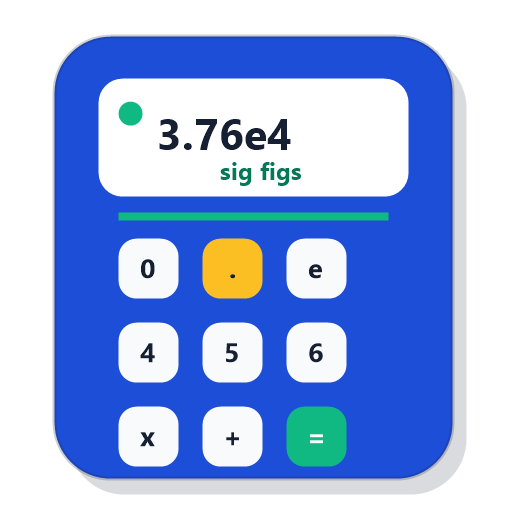
Example: 3.76 x 10^4
The coefficient 3.76 has 3 significant figures. The exponent 4 does not add or remove significant figures.
Example: 1.00 x 10^2
This notation shows that 100 should be read with 3 significant figures.
Addition and subtraction use decimal places
For addition and subtraction, do not round by the fewest significant figures. Instead, round the final answer to the least precise decimal place among the measured inputs.
Example: 12.5 + 0.003
12.5 is precise to tenths, while 0.003 is precise to thousandths. The raw result 12.503 is reported as 12.5.
Multiplication and division use the fewest sig figs
For multiplication and division, count the significant figures in each measured input. The final answer should have the same number of significant figures as the least precise measured input.
Example: 2.50 x 3.1
2.50 has 3 significant figures and 3.1 has 2. The raw product 7.75 is reported as 7.8.
Exact numbers usually do not limit precision
Counted values and defined constants are exact in many chemistry and physics problems. They usually do not reduce the number of significant figures in the final measured answer.
Example: 3 trials
If you repeat a measurement 3 times, the counted number 3 is exact. The measured values determine the significant figures.
Round the final answer, not every intermediate step
In most lab calculations, keep extra digits while you work. Rounding too early can create a final answer that is less accurate than the measurement supports.
Final-step rounding
Use the significant-figures rule or decimal-place rule after the arithmetic is complete, unless your class explicitly tells you otherwise.
Common mistakes to avoid
Most significant-figures mistakes come from treating every zero the same, using the wrong arithmetic rule, or rounding too early. Check the notation first, then check the operation.
Mistake: counting every zero
The zeros in 0.00450 do not all behave the same. The leading zeros do not count, but the final decimal zero does.
Mistake: using one rule for every operation
Addition and subtraction use decimal places. Multiplication and division use the fewest significant figures.