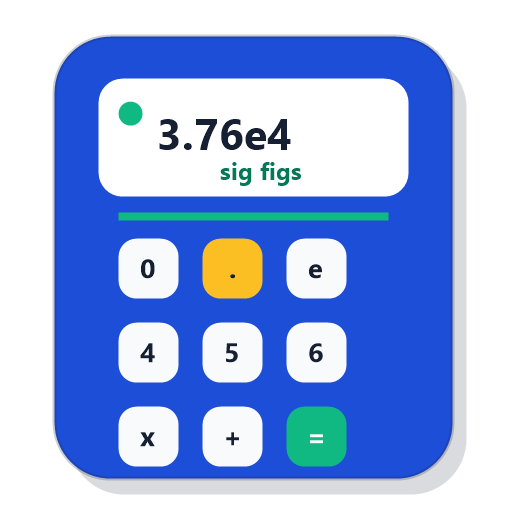
The coefficient carries the precision
In scientific notation, the coefficient carries the significant figures. The power of ten changes the size of the value, but it does not add measured digits or remove measured digits.
Example: 3.76 x 10^4
The coefficient 3.76 has 3 significant figures; the power of ten does not add digits to the count.
Lab-report check
If a report shows 3.76 x 10^4 g, the precision is controlled by 3.76, not by the exponent 4.
Use notation to remove ambiguity
Whole-number trailing zeros can be ambiguous. Scientific notation makes the intended precision visible because every digit in the coefficient is part of the significant-figures count.
Example: 1 x 10^2
This notation shows 1 significant figure because only the digit 1 appears in the coefficient.
Example: 1.0 x 10^2
This notation shows 2 significant figures because the zero after the decimal point counts.
Example: 1.00 x 10^2
The two zeros after the decimal point are significant, so this notation shows 3 significant figures.
Small values become easier to read
Small decimal values often have leading zeros that do not count. Scientific notation removes those placeholder zeros and leaves the measured digits in the coefficient.
Example: 4.50 x 10^-3
The leading zeros disappear in scientific notation, but the final zero in 4.50 still counts.
Original value: 0.00450
0.00450 and 4.50 x 10^-3 both show 3 significant figures: 4, 5, and the final decimal zero.
How to convert a number to scientific notation
Move the decimal point until the coefficient is at least 1 and less than 10. Then count only the digits written in that coefficient when deciding the significant figures.
Step 1
For 37600, move the decimal point to make 3.76. That gives 3.76 x 10^4 if the value is known to 3 significant figures.
Step 2
Choose how many digits belong in the coefficient based on the measurement precision, not based only on how many zeros the original number had.
Rounding in scientific notation
When rounding a value in scientific notation, round the coefficient to the required number of significant figures and keep the power of ten attached to the result.
Example: 3.76 x 10^4 to 2 sig figs
Round the coefficient 3.76 to 3.8, so the result is 3.8 x 10^4.
Example: 9.99 x 10^2 to 2 sig figs
Rounding 9.99 to 2 sig figs gives 10, so rewrite the result as 1.0 x 10^3 to keep standard scientific notation.
Common mistakes with exponents
The exponent is not part of the significant-figures count. Students often overcount by treating the exponent as another digit, or undercount by removing zeros that are written in the coefficient.
Mistake: counting the exponent
3.76 x 10^4 has 3 significant figures, not 4. The exponent tells scale, not precision.
Mistake: dropping coefficient zeros
1.00 x 10^2 has 3 significant figures. Writing 1 x 10^2 would change the reported precision.
When to use scientific notation in lab reports
Use scientific notation when a plain number would hide the precision. It is especially useful for large whole numbers with trailing zeros and very small decimals with many leading zeros.
Clear report wording
Write the value as 1.00 x 10^2 when you need readers to see that the measurement is reported to 3 significant figures.